
Ex-NYPD patrol chief named consulting chief in New Orleans: former chief of patrol for NYC Police Department will serve temporarily as “consulting Chief of Operations” for undermanned department →
New Orleans moves to end federal oversight of police →
-CTV NEWS
🔷”New Orleans officials asked a federal judge Tuesday to end court-supervised oversight of its police department under a pact negotiated with the U.S. Justice Department a decade ago, after deadly police shootings of civilians following Hurricane Katrina cast renewed scrutiny on the scandal-plagued department. The consent decree was approved by a federal judge in January 2013. It was the result of a 2011 Justice Department investigation invited by then-Mayor Mitch Landrieu, who took office in 2010.”
🔷“The hearing was set after Mayor LaToya Cantrell and Police Chief Shaun Ferguson publicly called for termination of the pact, describing it, now, as an unnecessary bureaucratic burden on a department that is short on manpower amid pandemic-era boost in violent crime. ‘Any systemic violations of federal law were remedied years ago,’ according to the city's filing Tuesday. In an accompanying memo, the city's attorneys argue that even if the court finds that the city hasn't reached full compliance with all elements of the decree, ‘it is undeniable that NOPD has substantially and materially satisfied the constitutional goals of the Decree in good faith, and eliminated the systemic violations of federal law identified by the DOJ's 2011 investigation.’” 🤣
🔷”The motion to end the consent decree comes as gunshot deaths and carjackings have increased in the past two years, while the department has dwindled to well under 1,000 people, down from more than 1,300 a few years ago. Cantrell has said the bureaucratic demands imposed by the decree add to the workload on the dwindling force.”
🔷👉”Still, some are skeptical that the consent decree is the main problem.” 👈
AUGUST 19, 2022: Mayor Cantrell: 'We are not canceling Mardi Gras': Cantell made statement a little under a day after telling a town hall meeting it could be in jeopardy if police shortage continues. →
AUGUST 18, 2022: No Mardi Gras 2023? Mayor Cantrell says dwindling police force could call off Carnival Season →
-NEWS 19 ALABAMA
🔷“If we don’t have adequate police, it could mean that there will be no Mardi Gras — and that’s a fact. If our officers cannot be safe, then there’s no way that our city will be safe,” said Cantrell.
New Orleans Mayor LaToya Cantrell defends France trip spending, choice in supporting teen accused in carjacking →
-WDSU NEWS
🔷”The New Orleans mayor held a news conference Wednesday night where she defended her recent trip to France as well as her decision to support a teen in court who was accused of carjacking. Documents obtained by WDSU showed Cantrell spent $43,000 for the trip. A total of $17,000 was spent on her flights. Documents obtained by WDSU showed Cantrell spent $43,000 for the trip. A total of $17,000 was spent on her flights. Wednesday, leaders with the Police Association of New Orleans and the Firefighters Union weighed in on Cantrell's spending. Her trip cost more than the average starting salary for a New Orleans Firefighters, which is $41,000 a year. And for a starting NOPD recruit, which is $40,391.”
🔷”Cantrell said the trip was necessary to promote the city of New Orleans.”
🔷”She said she does not regret supporting a young person who was willing to make better decisions. Madison Bergeron, one of the victims of the teenager, called the mayor's statement a proverbial slap in the face.”
Moon Landrieu Dies at 92; New Orleans Mayor Championed Integration →
Trump should fill Christians with rage. How come he doesn’t? →
The super-rich ‘preppers’ planning to save themselves from the apocalypse →
-THE GUARDIAN
🔷”Tech billionaires are buying up luxurious bunkers and hiring military security to survive a societal collapse they helped create, but like everything they do, it has unintended consequences.”
‘These Kids Are Dying’ — Inside the Overdose Crisis Sweeping Fort Bragg: →
-ROLLING STONE
🔷”A staggering total of 109 soldiers assigned to Fort Bragg died in 2020 and 2021. Dozens have lost their lives there to drug overdoses. Now, their families are demanding answers — and accountability.”
FLASHBACK 1787: Franklin's Proposal for Prayer →
-NATIONAL PARK SERVICE
🔷"We shall be divided by our little partial local interests; our projects will be confounded; and we ourselves shall become a reproach and by-word down to future ages...I therefore beg leave to move — that henceforth prayers imploring the assistance of Heaven, and its blessings on our deliberations, be held in this Assembly every morning before we proceed to business, and that one or more of the clergy of this city be requested to officiate in that service.” — Benjamin Franklin, in James Madison's Notes on the Federal Convention
FLASHBACK 1944: Franklin D. Roosevelt’s Prayer During Dark Times →
-CONGRESSIONAL PRAYER CAUCUS FOUNDATION
🔷”Almighty God: Our sons, pride of our nation, this day have set upon a mighty endeavor, a struggle to preserve our Republic, our religion and our civilization, and to set free a suffering humanity... Lead them straight and true; give strength to their arms, stoutness to their hearts, steadfastness in their faith. They will need Thy blessings. Their road will be long and hard. For the enemy is strong. He may hurl back our forces. Success may not come with rushing speed, but we shall return again and again; and we know by Thy grace, and by the righteousness of our cause, our sons will triumph... Embrace these, Father, and receive them, Thy heroic servants, into Thy kingdom. And for us at home--fathers, mothers, children, wives, sisters, and brothers of brave men overseas, whose thoughts and prayers are ever with them--help us, Almighty God, to rededicate ourselves in renewed faith in Thee in this hour of great sacrifice... Give us strength, too--strength in our daily tasks, to redouble the contributions we make in the physical and the material support of our armed forces. With Thy blessing, we shall prevail over the unholy forces of our enemy. Help us to conquer the apostles of greed and racial arrogances. Lead us to the saving of our country, and with our sister nations into a world unity that will spell a sure peace--a peace invulnerable to the schemings of unworthy men. And a peace that will let all men live in freedom, reaping the just rewards of their honest toil.”
— President Franklin D. Roosevelt D-Day June 6, 1944
Joe Biden goes all in against Trump and “MAGA Republicans”: He is running big risks, but necessary ones →
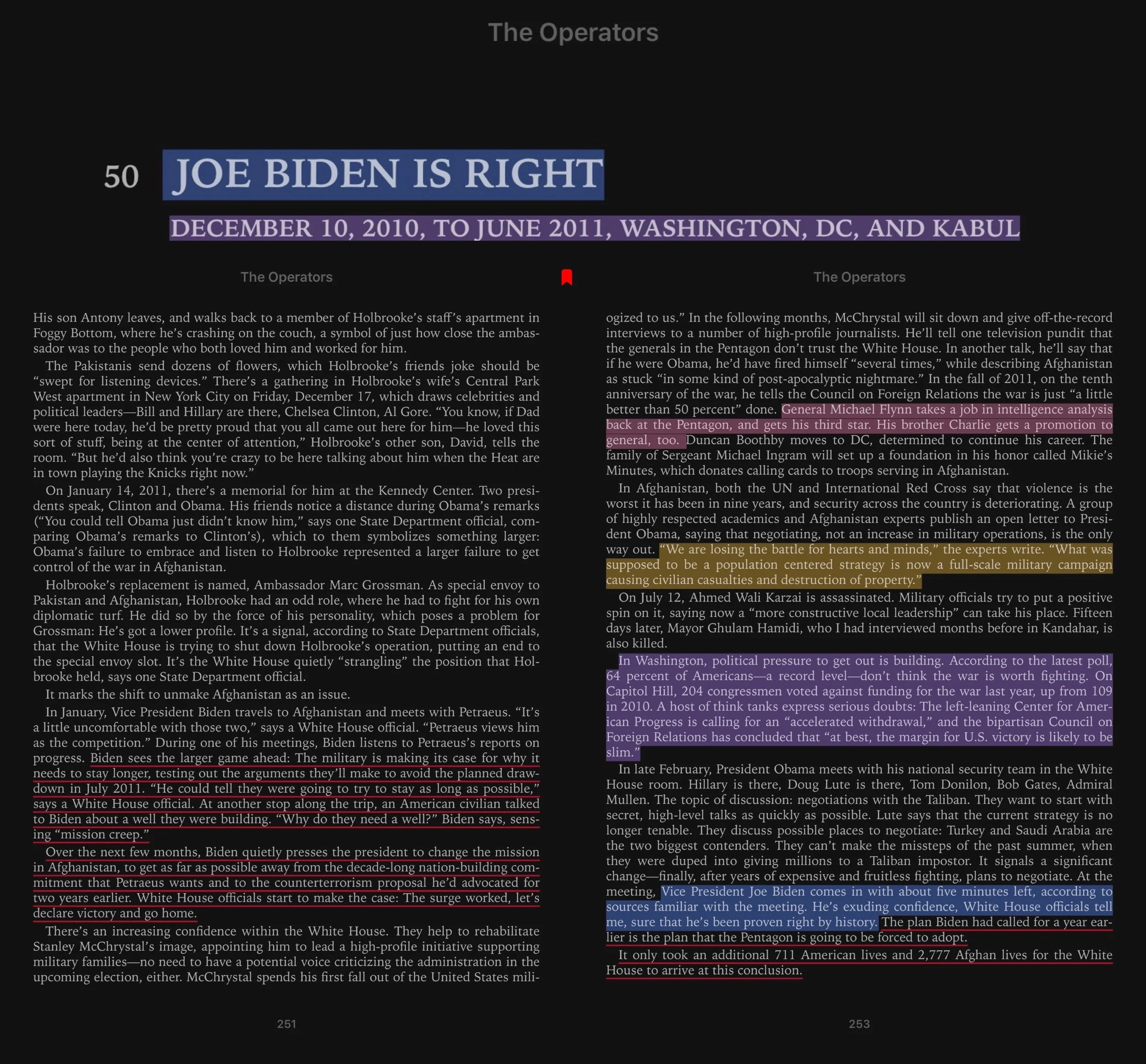
FLASHBACK 2011: Excerpt from "The Operators" by Michael Hastings [RIP]- Chapter 50. JOE BIDEN IS RIGHT. December 10, 2010 to June 2011, Washington DC & Kabul.
“In January, Vice President Biden travels to Afghanistan and meets with Petraeus. “It’s a little uncomfortable with those two,” says a White House official. “Petraeus views him as the competition.” During one of his meetings, Biden listens to Petraeus’s reports on progress. Biden sees the larger game ahead: The military is making its case for why it needs to stay longer, testing out the arguments they’ll make to avoid the planned drawdown in July 2011. “He could tell they were going to try to stay as long as possible,” says a White House official. At another stop along the trip, an American civilian talked to Biden about a well they were building. “Why do they need a well?” Biden says, sensing “mission creep.”
Over the next few months, Biden quietly presses the president to change the mission in Afghanistan, to get as far as possible away from the decade-long nation-building commitment that Petraeus wants and to the counterterrorism proposal he’d advocated for two years earlier. White House officials start to make the case: The surge worked, let’s declare victory and go home.
Two days after the report is finished, the White House announces that President Obama appointed McChrystal as an unpaid advisor to military families. Mary Tillman, Pat Tillman’s mother, is outraged. “It’s a slap in the face to all soldiers,” she says of the choice. “He deliberately helped cover up Pat’s death. And he has never adequately apologized to us.” In the following months, McChrystal will sit down and give off-the-record interviews to a number of high-profile journalists. He’ll tell one television pundit that the generals in the Pentagon don’t trust the White House. In another talk, he’ll say that if he were Obama, he’d have fired himself “several times,” while describing Afghanistan as stuck “in some kind of post-apocalyptic nightmare.” In the fall of 2011, on the tenth anniversary of the war, he tells the Council on Foreign Relations the war is just “a little better than 50 percent” done. General Michael Flynn takes a job in intelligence analysis back at the Pentagon, and gets his third star. His brother Charlie gets a promotion to general, too. Duncan Boothby moves to DC, determined to continue his career. The family of Sergeant Michael Ingram will set up a foundation in his honor called Mikie’s Minutes, which donates calling cards to troops serving in Afghanistan.
In Afghanistan, both the UN and International Red Cross say that violence is the worst it has been in nine years, and security across the country is deteriorating. A group of highly respected academics and Afghanistan experts publish an open letter to President Obama, saying that negotiating, not an increase in military operations, is the only way out. “We are losing the battle for hearts and minds,” the experts write. “What was supposed to be a population centered strategy is now a full-scale military campaign causing civilian casualties and destruction of property.”
On July 12, Ahmed Wali Karzai is assassinated. Military officials try to put a positive spin on it, saying now a “more constructive local leadership” can take his place. Fifteen days later, Mayor Ghulam Hamidi, who I had interviewed months before in Kandahar, is also killed.
In Washington, political pressure to get out is building. According to the latest poll, 64 percent of Americans—a record level—don’t think the war is worth fighting. On Capitol Hill, 204 congressmen voted against funding for the war last year, up from 109 in 2010. A host of think tanks express serious doubts: The left-leaning Center for American Progress is calling for an “accelerated withdrawal,” and the bipartisan Council on Foreign Relations has concluded that “at best, the margin for U.S. victory is likely to be slim.”
In late February, President Obama meets with his national security team in the White House room. Hillary is there, Doug Lute is there, Tom Donilon, Bob Gates, Admiral Mullen. The topic of discussion: negotiations with the Taliban. They want to start with secret, high-level talks as quickly as possible. Lute says that the current strategy is no longer tenable. They discuss possible places to negotiate: Turkey and Saudi Arabia are the two biggest contenders. They can’t make the missteps of the past summer, when they were duped into giving millions to a Taliban impostor. It signals a significant change—finally, after years of expensive and fruitless fighting, plans to negotiate. At the meeting, Vice President Joe Biden comes in with about five minutes left, according to sources familiar with the meeting. He’s exuding confidence, White House officials tell me, sure that he’s been proven right by history. The plan Biden had called for a year earlier is the plan that the Pentagon is going to be forced to adopt. It only took an additional 711 American lives and 2,777 Afghan lives for the White House to arrive at this conclusion.
July 2011 is approaching. That’s the date Obama promised to start bringing troops home. In June, he holds a series of meeting with Petraeus. Obama tells Gates and Mullen to warn Petraeus—no leaks this time, no getting fucked by the press. No repeat of the “Seven Days in May dynamic” of 2009, says one national security official to a reporter—a reference to the film about American military generals staging a coup against the president. Petraeus is playing nice. Obama meets with Petraeus three times—he wants options for the drawdown. Petraeus suggests keeping the thirty thousand troops until the end of 2012. Petraeus wants to move the troops to eastern Afghanistan, where the fighting has gotten worse. Obama shuts the door on the plan. He says he’s going to bring ten thousand home by the end of the year, and twenty thousand more home by the end of the summer of 2012. Petraeus’s allies complain to the press, and the next general in charge of the war, General John Allen, will go on the record to say that the president isn’t following the military’s advice. What the president decided, says Allen, “was a more aggressive [drawdown] option “than which was presented,” and “was not” what Petraeus had recommended.
This time, though, the charges don’t stick. Obama has regained control of his policy from the Pentagon. The war is too unpopular, the myth of progress too obviously a lie.
Obama gives a speech on June 24, 2011, announcing his decision to start the drawdown. “The tide of war is receding,” he says. “It’s time to focus on nation-building here at home.”
Why the Hell Isn’t Biden Ending the Federal War on Cannabis? JUST RUN THE BALL IN, JOE. →
FLASHBACK: The Joe Biden Plagiarism Case →
FLASHBACK 2021: A Lesson for Biden- JFK Went Up in Polls After Bay of Pigs: 1961 Cuba invasion was epic presidential botch—& yet, Kennedy’s standing improved afterward. Take note, Mr. President. →
FLASHBACK 2021: What Biden is keeping secret in the JFK files →
-POLITICO
🔷10/24/2021: "‘President Joe Biden has once again delayed the public release of thousands of government secrets that might shed light on the 1963 assassination of President John F. Kennedy. “Temporary continued postponement is necessary to protect against identifiable harm to the military defense, intelligence operations, law enforcement, or the conduct of foreign relations that is of such gravity that it outweighs the public interest in immediate disclosure,” Biden wrote in a presidential memorandum late Friday. He also said that the National Archives and Records Administration, the custodian of the records, needs more time to conduct a declassification review due to delays caused by the coronavirus pandemic.’
FLASHBACK 2013: The Real Conspiracy Behind the JFK Assassination: Oswald was the lone shooter, but there was a plot involved in the president’s death—and it was in plain sight. →
FLASHBACK 2017: JFK files: As Donald Trump looks to release classified documents, last living link to assassination drops bombshell →
-THE INDEPENDENT UK
🔷”The direction of the Cuban revolution was not inevitably destined for socialism. However, when Washington refused to deal with Castro following his victory, he was forced to turn to the Soviet Union. Veciana would himself turn against Castro, and was recruited by the CIA in their covert action operations. This secret war, waged relentlessly against Cuba, consisted of economic and industrial sabotage, as well as acts of terrorism. Veciana concedes that he was an unlikely terrorist: a skinny, asthmatic, insecure youngster.
Once his prominence brought him to the attention of Cuban security services, Veciana had no option but to flee for Miami on a boat. With funding and support from the CIA, he founded Alpha 66, which became one of the most notorious Cuban exile groups. In 1963, Veciana and Alpha 66 would make headlines all over the world after holding a press conference claiming responsibility for an attack on a Russian vessel in Cuban waters.”